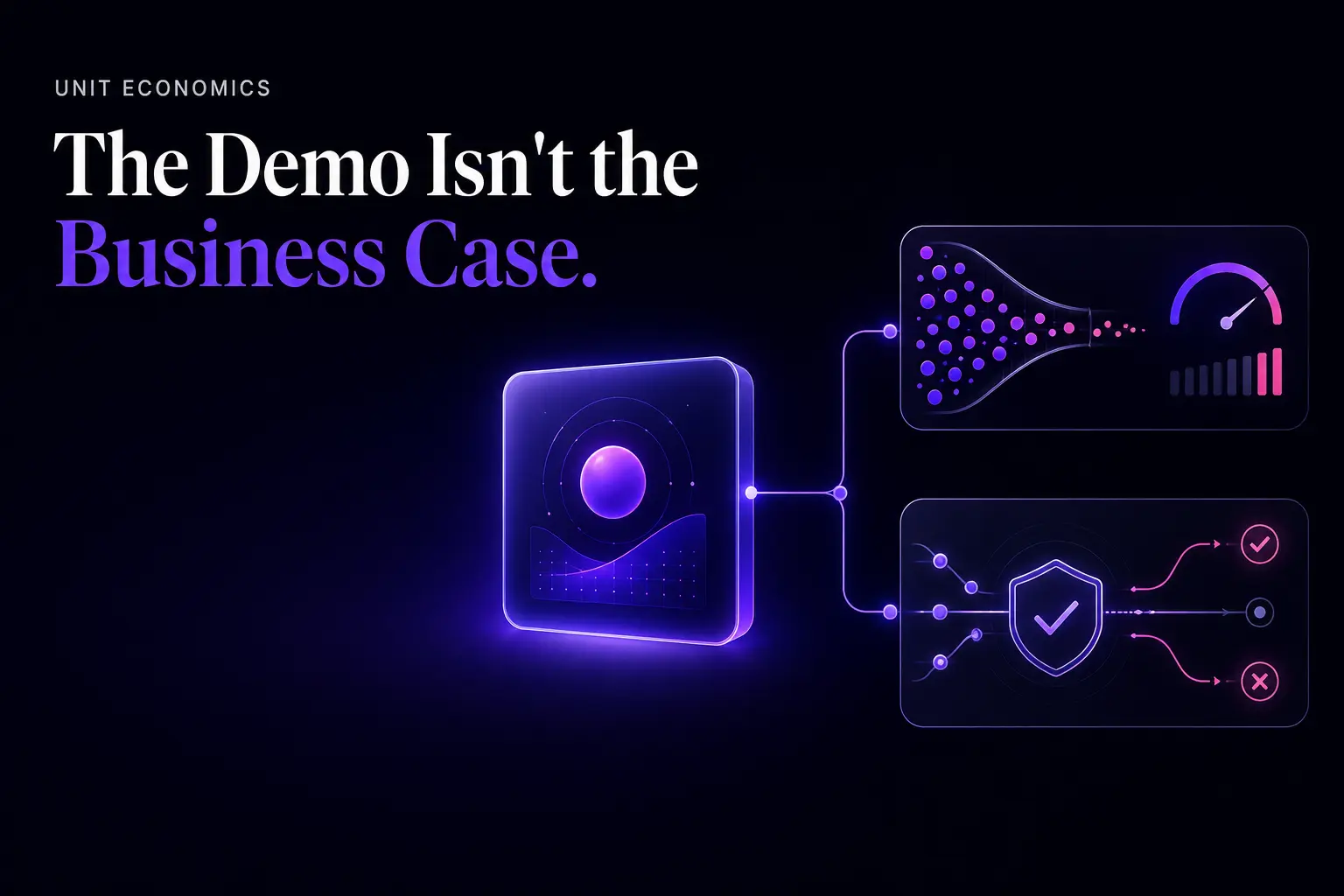
A slick AI agent demo is a genuinely exciting thing to watch. The agent takes a messy request, reasons through it, calls a few tools, and hands back something useful in seconds. It is easy to walk away from that moment convinced the product is basically done. But there is a question the demo never answers, and it is the one the business actually rests on: what are the agent’s unit economics?
A demo shows that something is possible. Unit economics show whether it is viable. Those are not the same finding, and the gap between them is where a lot of promising AI products quietly get into trouble.
What does one run actually cost?
The first question is the most concrete one. Every time the agent completes a task, it consumes tokens, and those tokens have a price. So what does a single successful run really cost once you add up the model calls, the retries, the tool usage, and the context it has to carry?
The number matters most when you set it next to what you charge. If the agent burns four dollars of tokens to do a task the product charges three dollars for, the demo still looks flawless while every single use loses money. Nothing on screen tells you this. It only shows up when someone works out the cost per run and compares it to the price, and that arithmetic is easy to postpone in the excitement of a working prototype.
Does the cost hold when it scales?
The second question is what happens to that math as usage grows. A cost that is comfortable at a hundred runs a week can behave very differently at ten thousand users. Some costs stay flat, some fall with volume, and some quietly climb as usage patterns get heavier and edge cases multiply.
The outcome you want to rule out is the one where the margin inverts the moment the product succeeds — where growth, the thing you were aiming for, is exactly what turns a healthy-looking feature into a loss. Understanding whether your economics improve or decay with scale is not a detail to sort out later. It is the difference between a product that gets stronger as it grows and one that gets more expensive to keep alive.
Who is accountable when the agent gets it wrong?
The third question is not about money, and it is often the one skipped entirely. When an agent acts on a customer’s behalf and gets it wrong — books the wrong thing, sends the wrong message, makes a decision with real consequences — who owns that outcome? The company that shipped the agent, the customer who trusted it, or the vendor whose model produced the result?
A demo runs in a friendly environment where mistakes are harmless. Real use does not. The moment an agent can take actions that affect someone, accountability stops being a philosophical question and becomes a practical one that shapes your design, your terms, and your support. Deciding it deliberately, before the first real mistake, is far better than discovering the answer during one.
The demo is a feature. The business case is something else.
It is easy to fall in love with a demo and skip every one of these questions, because the demo feels like proof and the questions feel like friction. But the demo and the business case are two different things.
The demo shows that the feature works. The business case is whether that feature has positive margin at the scale you are aiming for, and whether there is someone clearly accountable when it fails. A feature can be technically impressive and commercially unworkable at the same time, and only the second set of questions will tell you which one you have.
This is a close cousin of a theme we return to often: the distance between something that demonstrates well and something ready for the real world. We wrote about the engineering side of that gap in moving from vibe coding to production-ready AI. Unit economics and accountability are the business side of the very same gap.
How we think about it at Appening
When we help teams build with AI agents, we try to treat the demo as the start of the evaluation rather than the end of it. That means working out the cost per run early, pressure-testing whether the economics survive scale, and being clear about who is accountable when an agent acts and gets something wrong. These are not reasons to avoid building agents. They are how you build one that still makes sense as a business once real users arrive.
The exciting part and the durable part of an AI product are rarely the same thing, and the work is in making sure the exciting demo is backed by economics and accountability that hold up.
If you are building an AI agent and want to know whether the business case is as strong as the demo, we are happy to help you work through the numbers and the risks. Book a free 30-minute consultation and we will look at what a run really costs you, how it behaves at scale, and where accountability needs to sit.