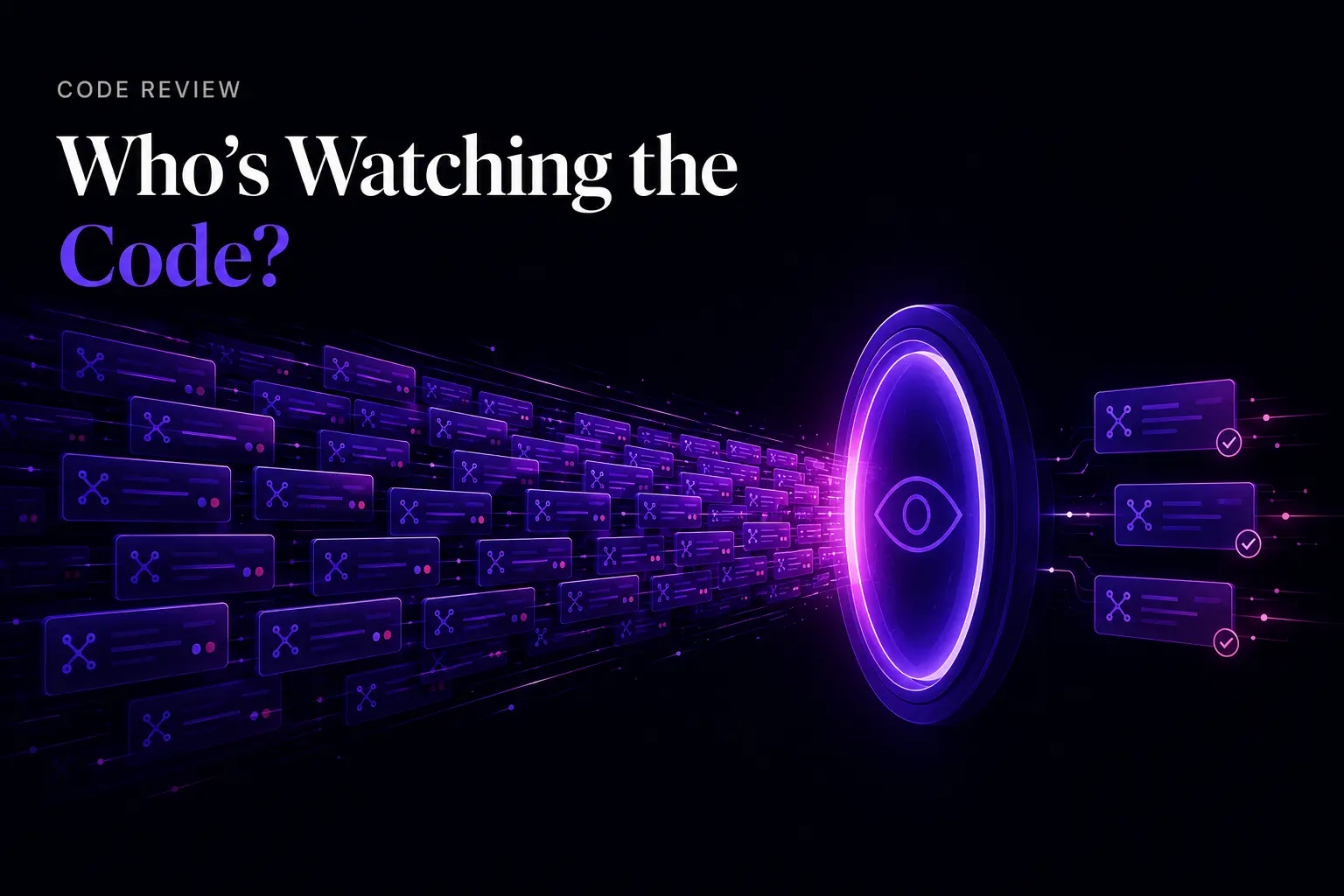
AI is making developers write code faster. Not a little faster — a lot faster. And that speed lands somewhere specific in a team: it lands on the people who review the code. Senior engineers and tech leads who used to see a manageable stream of pull requests are suddenly facing a flood of them.
When the volume climbs past what careful review can keep up with, something has to give. Usually it is the review itself. Reviews get shallower. Approvals get faster. And slowly, almost without anyone deciding it, the codebase stops being watched the way it used to be.
The quiet trap
This is the trap, and it is easy to walk into because every individual step looks reasonable. A reviewer with forty pull requests waiting cannot give each one the attention they gave when there were four. Approving quickly feels like helping the team move. No single fast approval causes a problem. It is the accumulation of them, over weeks, that changes what a team actually knows about its own system.
We have been so focused on making code generation faster that it is easy to forget what code review was doing all along. It was never only about catching bugs.
What code review was really for
Catching defects is the part of review that is easiest to name, so it gets treated as the whole point. It is not. A good review has always done quieter, more important work underneath.
It is knowledge transfer. When a second engineer reads through a change and understands why it was made this way, the understanding of that part of the system now lives in more than one head. Review is how a team keeps a shared mental model of its own codebase alive — how the person who wrote a module and the two people who reviewed it all carry a piece of the same picture.
That shared picture is what lets a team move confidently. It is why someone can pick up a teammate’s work when they are out, why a change in one corner does not quietly break another, and why the system stays comprehensible as it grows. Review is one of the main ways that understanding gets distributed instead of trapped in one person.
What actually breaks
So when review thins out under the weight of AI-generated volume, the loss is bigger than a messier codebase. You get a team where nobody fully understands what they are sitting on.
The code still runs, which is what makes this so easy to miss. Everything looks fine right up until the moment someone needs to change something important, and discovers that the understanding required to change it safely was never shared — or worse, never existed, because the code was generated and approved without anyone truly reading it. A system that no one understands is fragile in a way that does not show up on any dashboard until it fails.
Keeping review meaningful when code is cheap
The answer is not to slow code generation back down. The speed is worth having. The answer is to be deliberate about protecting what review was quietly providing, now that the volume has changed.
Part of that is right-sizing what review focuses on. When a machine can produce a hundred lines in seconds, reading every line with equal attention is neither possible nor the point. The attention is better spent on intent and structure: does this change fit the architecture, is the approach sound, will the next person understand why it exists. The reviewer’s judgment matters more than ever, applied where it counts most.
Part of it is cultural. A team can decide, explicitly, that shared understanding is something it will not trade away for throughput — that generated code still gets read by a human who can explain it, and that keeping the mental model alive is part of the job rather than an afterthought. This connects directly to a rule we keep coming back to in production-ready AI: don’t ship code no one on the team can explain. Review is where that rule is enforced in practice.
How we think about it at Appening
In our own work, we treat review as one of the places where engineering judgment earns its keep, not a checkbox to clear on the way to merging. As AI raises the volume of code, we lean on review even more deliberately — to keep the architecture coherent, to keep understanding distributed across the team, and to make sure speed at the keyboard does not quietly become fragility in the system.
The pattern underneath all of this is the same one we keep seeing. AI changes what is cheap, and in doing so it puts new pressure on the human practices that were holding quality together. The teams that do well are the ones that notice which of those practices still matter and protect them on purpose.
If your team is generating code faster than it can meaningfully review it, we are happy to help you find a rhythm that keeps both the speed and the shared understanding. Book a free 30-minute consultation and we will talk through where AI can accelerate your team and where human review still needs to hold the line.