Andrej Karpathy gave a name to something a lot of people were already feeling. In early 2025 he described “a new kind of coding I call vibe coding, where you fully give in to the vibes, embrace exponentials, and forget that the code even exists.” You describe what you want, the model writes it, and something real appears on the screen minutes later.
The term spread because it captured a genuine shift. Building a working prototype used to take weeks. Now it can take an afternoon. That change is worth celebrating, and it has opened the door for far more people to turn an idea into something they can click through and react to.
It also raises a quieter question that matters a great deal once an idea starts to work: what has to be true before other people can depend on it?
Vibe coding is a real superpower for the early stage
There is a version of this conversation that treats vibe coding as a shortcut people should feel bad about. We see it differently. For exploration, it is one of the most useful things to happen to software in years.
Simon Willison, co-creator of the Django web framework, has written some of the clearest thinking on this. His take on the early stage is direct:
If you’re vibe coding something for yourself, where the only person who gets hurt if it has bugs is you, go wild.
A prototype is close to free now. You can describe an interface, watch a model build a convincing version of it, and learn more in an afternoon of clicking than in a week of planning documents. When the stakes are a personal tool or a throwaway experiment, speed is the whole point, and reviewing every line would only slow down learning. Teams that use this well move through ten ideas in the time it used to take to build one.
What changes the moment other people depend on it
The picture changes when the same code moves from your screen to someone else’s hands. Willison draws the line clearly:
The moment you ship your vibe coding code for other people to use, where your bugs might actually harm somebody else, that’s when you need to take a step back.
That is the sentence worth sitting with. A bug in a weekend project costs you a little time. A bug in software that handles a customer’s payment, a patient’s record, or a founder’s launch can cost someone else something real. The code did not get more complicated between those two moments. The consequences did.
This is why Willison later proposed a companion term, “vibe engineering,” for what happens when experienced engineers use these same AI tools with care rather than abandon. Same tools, different discipline. The difference is not the model you prompt. It is what you do with what it gives back.
The bottleneck moved, and it moved somewhere specific
For most of software’s history, the hard question was “can we build this?” Building was slow, so the ability to build was the scarce thing.
AI coding tools have largely answered that question. For a wide range of products, yes, it can be built, and quickly. So the scarce question has shifted to a different one: “is this ready for real use?” That is now where projects get stuck, and it is a genuinely harder question than it sounds.
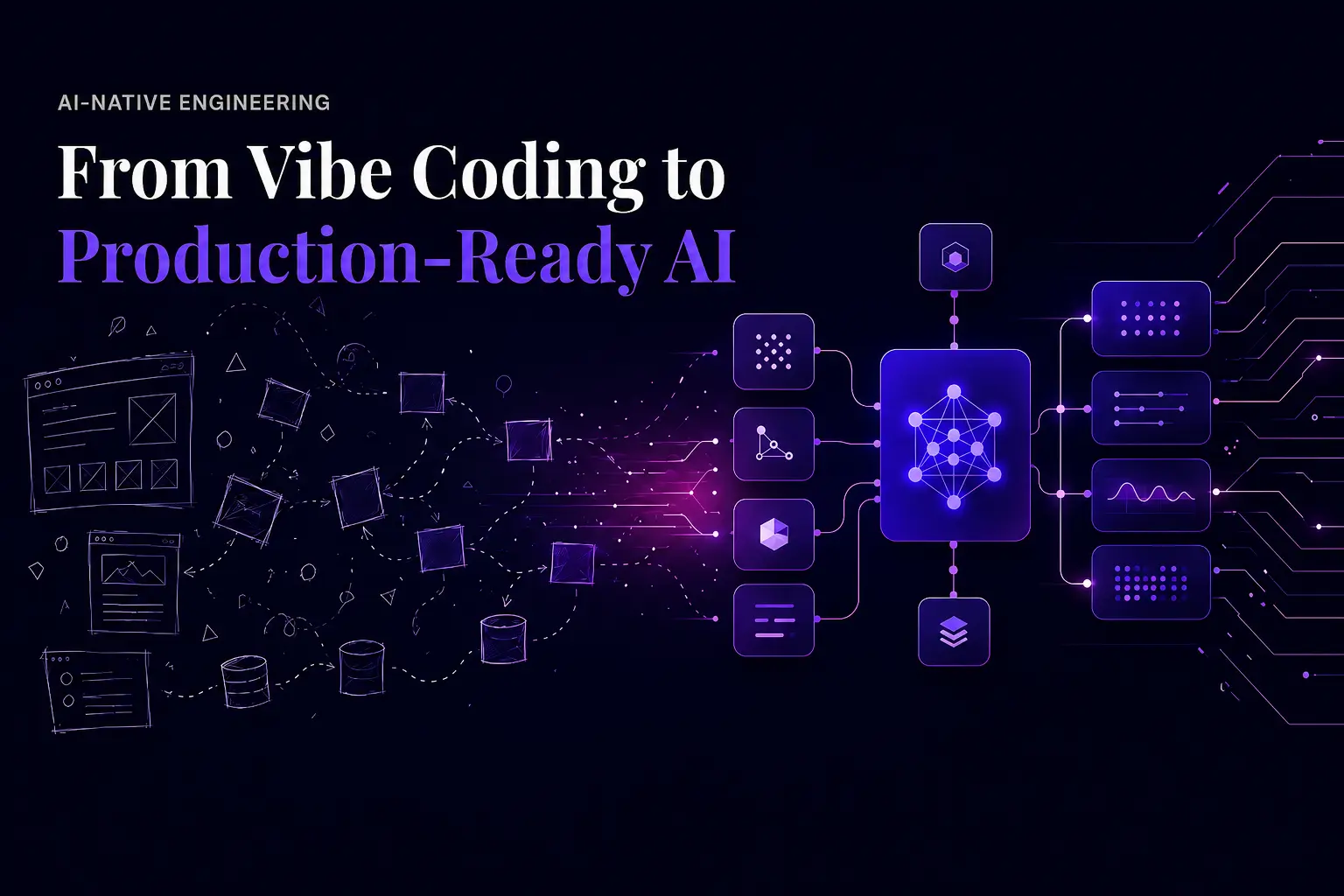
Getting to a convincing demo and getting to production-ready are separated by a set of problems that a fast first draft tends to skip. What happens under real load? What happens when a user does something unexpected? Where does sensitive data live, and who can reach it? When an AI agent takes an action on a user’s behalf, what stops it from taking the wrong one? None of these show up in a five-minute demo, and all of them show up in week three of real usage.
What production-ready actually asks of you
Production readiness is less a feature and more a set of habits applied to the code an AI helps you write. A few of them carry most of the weight.
Code you can explain. Willison offers a golden rule that travels well: “I won’t commit any code to my repository if I couldn’t explain exactly what it does to somebody else.” A model can produce a working function you have never read. That is fine for a sketch and risky for a system, because you cannot safely change, secure, or debug code you do not understand.
Testing that reflects real conditions. A demo proves the happy path works once. Test coverage proves the unhappy paths are handled every time, which is what real users generate constantly.
Security and safe agent design. AI agents are powerful precisely because they can act, which means the design has to define clearly what they are allowed to do, what they never do without a human, and how secrets and private data stay protected. This is architecture work, and it is difficult to retrofit after the fact.
Architecture that can hold weight. The structure that lets a prototype run for one person is often not the structure that lets a product serve thousands. Deciding where that line is, and building past it before it breaks, is judgment that comes from having shipped real systems.
None of these replace the speed AI gives you. They are what let you keep that speed without paying for it later.
The real gap is the people who can wield the tools
Here is the pattern we keep coming back to. The AI models and the platforms built on them are already strong enough to generate production-grade code. The constraint is rarely the tool. It is whether someone in the room can direct that tool with clear intent, recognize when its output is quietly wrong, and make the architecture and security decisions the model will not make on its own.
AI amplifies engineering skill. Where that skill is present, the results compound: more value, in less time, at lower cost. Where it is absent, the same tools produce something that looks finished and behaves unpredictably the moment it meets real users. The teams shipping well right now are not simply the ones moving fastest. They are the ones moving quickly while keeping the fundamentals intact, because they have people who know which fundamentals cannot be skipped.
How we think about it at Appening
We have worked with AI coding agents since the early days, when they were rough and needed a lot of steering. For over a year, our team has built primarily through app builders, coding agents, and AI-native tooling rather than writing code by hand, using engineering fundamentals to guide those tools toward code that holds up. That approach is why we can take an early idea and make it production-ready in weeks: lower cost, faster time to market, and a short loop from feedback to release.
The goal is not to move faster for its own sake. It is to move quickly on the parts that should be quick, and to bring real engineering judgment to the parts that protect the people who will eventually depend on the software.
If you are integrating AI into your product right now, a fair question to ask yourself is which side of the line you are on: exploring freely with a prototype, or building something your users are about to rely on. Both are valid. They just call for different care.
If you would like to talk through what production-ready AI looks like for your specific product, we’re happy to help. Book a free 30-minute consultation and we’ll walk through where you are and what it would take to ship with confidence.
Table of Contents