A new model tops the benchmarks every few weeks. The one you built on six months ago is probably not the best option anymore, and the one you would pick today likely will not be the best option six months from now. This is not a temporary phase that settles down once the dust clears. For the foreseeable future, it is the weather.
So here is the question worth sitting with, because your architecture has already answered it whether you meant to or not: if a better model dropped tomorrow, how long would it take you to switch to it?
If the honest answer is “that would be a rewrite,” then the bet was placed in the wrong spot. Not because the model you chose was wrong, but because your system was built as though the choice were permanent, in a world where it is anything but.
The ground under AI products has shifted
For a while it made sense to treat the model as the heart of an AI product — the hard-won center everything else attached to. That assumption is quietly expiring. The context that makes a model useful for a specific user is increasingly portable. In many setups you can now export what the system knows about a user — their history, their preferences, the accumulated state that makes the experience feel tailored — and carry it to a different model in a short amount of time.
When you do, you often recover most of the performance almost immediately. Not because all models are identical, but because a large share of what felt like the product’s intelligence was never really living in the model. It was living in the context wrapped around it. The model was doing the reasoning, but the context was doing the personalization, and only one of those two is hard to move.
That changes what the model actually is in your stack. It is no longer the irreplaceable core. It is the cheapest, most swappable part — a component you should expect to replace more than once over a product’s life. Architecting as though it were permanent is building on the one piece that is guaranteed to change.
Your moat is the context layer you own
If the model is not the moat, it is fair to ask what is. The answer is the part that does not travel to your competitors: the context layer you own. Your data. Your workflows. The history you have accumulated about your customers and the specific problems they are trying to solve.
That layer is genuinely yours in a way a model never is. Any competitor can call the same model you call, often on the same day you get access to it. What they cannot do is instantly reproduce the years of workflow refinement, the proprietary data, and the deep record of customer behavior that make your product fit its users the way it does. Two products can sit on the identical model and deliver completely different value, and the difference is almost entirely in the context and the system around it.
This is why the model being swappable is good news rather than a threat. When the intelligence is a commodity you can buy from several vendors, the competition moves to the layer where you actually have an advantage — and that is the layer you build and own, not the one you rent.
Why the abstraction has to sit in the right place
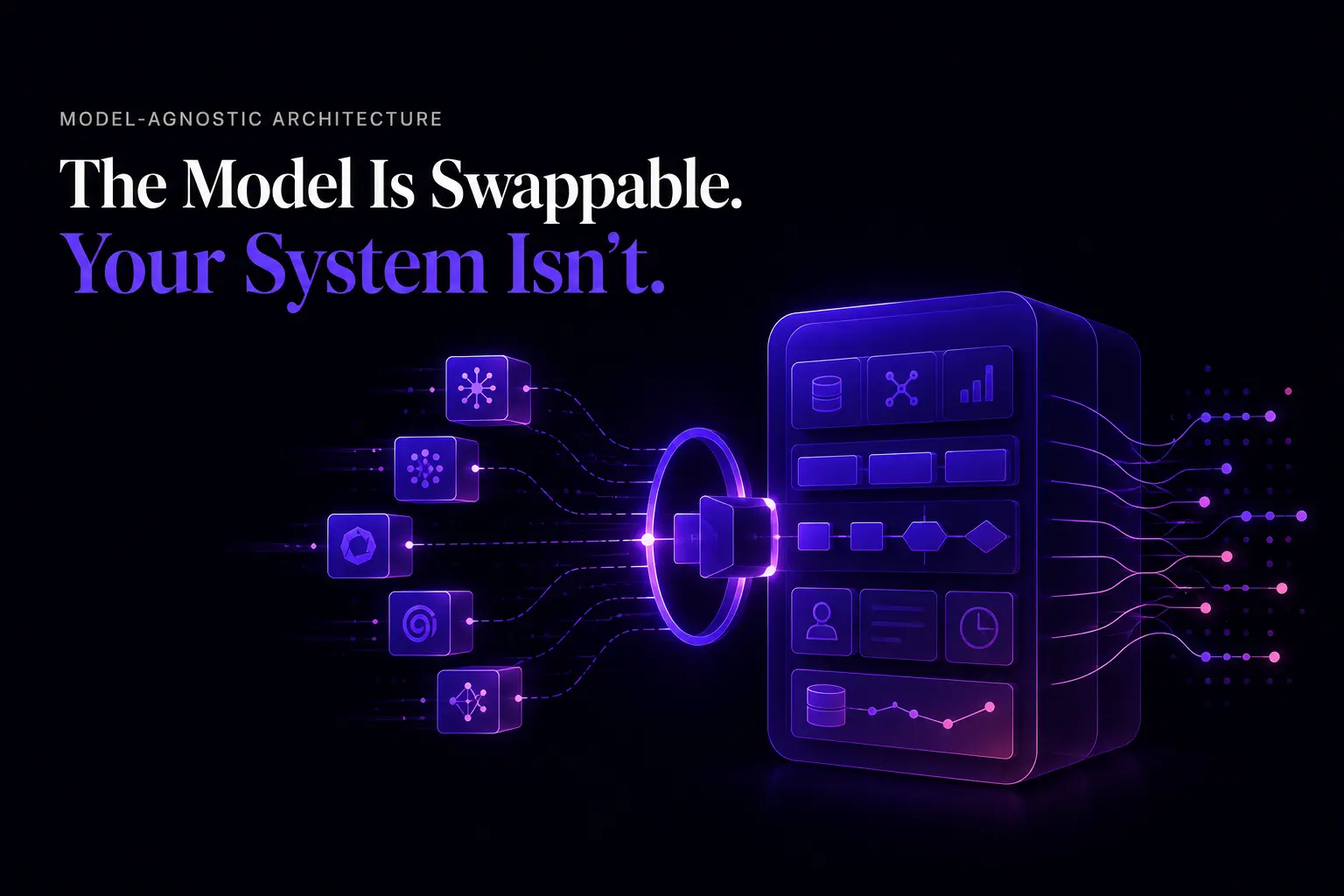
Models leapfrog each other every few months. Given that, the goal is an architecture where adopting a better one is a configuration change and an evaluation run, not a project. When switching a model costs you a rewrite, it is a sign the abstraction was built in the wrong place — that model-specific assumptions leaked into parts of the system that should never have known which model they were talking to.
A model-agnostic architecture keeps that boundary clean. The model sits behind a thin, well-defined interface. Your prompts, your orchestration logic, your context assembly, and your evaluation suite all live on your side of that line and do not care which vendor is answering. When something better appears, you point the interface at it, run your evaluations to confirm the behavior holds, and move on. The cost of switching drops from months to an afternoon, and you get to actually take advantage of a fast-moving field instead of being trapped by the last good decision you made.
None of this is exotic engineering. It is the ordinary discipline of putting the volatile thing behind a boundary and keeping the durable things — your context, your logic, your tests — independent of it. The teams that do this quietly benefit every time the frontier moves. The teams that do not pay for the same upgrade with a rebuild.
Build versus buy, pointed the right way
All of this reframes the oldest question in the book. For AI products, the useful version of build versus buy is this: buy the intelligence, and build the system around it.
Buy the intelligence, because the model is a commodity input produced by vendors spending enormous sums to push it forward, and you cannot and should not try to out-build that. Build the system, because the system is where your advantage actually lives — the context layer, the workflows, the evaluations, the accountability, the parts competitors cannot copy by signing up for the same API.
Get this backwards — treat the model as the thing you carefully build around and permanently commit to, while the system stays thin — and you sign yourself up to rebuild annually, chasing a frontier you structured yourself to fall behind. This connects to a distinction we keep coming back to in production-ready AI and in the unit economics of AI agents: the impressive part and the durable part of an AI product are rarely the same thing, and the durable part is almost always the system, not the demo or the model powering it.
How we think about it at Appening
When we help teams build with AI, we try to treat the LLM as a commodity input from the very first architectural decision — something to keep behind a clean boundary and swap without ceremony — and to pour the real engineering into the part competitors cannot copy. That means investing in the context layer, keeping orchestration and evaluation independent of any single vendor, and designing so that the next great model is an upgrade you get to enjoy rather than a migration you have to survive.
The frontier is going to keep moving. That is a gift to the teams built to absorb it and a tax on the teams built to resist it. The difference between the two is almost entirely a matter of where the abstraction sits and where the engineering went.
So it is worth asking plainly: is your moat in the model, or in the system you wrapped around it? If you are not sure, or if the honest answer is that switching models today would hurt, we are happy to help. Book a free 30-minute consultation and we will look at where your architecture is betting on the model staying still, and how to move that bet somewhere it can actually pay off.
Table of Contents