There is a shift happening in how products get built that does not get talked about enough, and it is easy to understate. The instinct is to say prototyping has gotten cheaper, or faster. That undersells it. For a growing range of ideas, prototyping is now essentially free.
Not free as in low cost. Free as in the effort of turning an idea into something real and clickable has dropped close to zero. That single change quietly rewrites how good product decisions get made.
What “free” actually means here
Consider the loop most teams have lived inside for years. You have an idea. You write a spec. You hand it to engineering. You wait two or three weeks. Something comes back. You look at it and realize the idea needed to change the moment you could finally see it. Then the loop starts again.
That loop still exists. What has changed is its length. The same cycle that used to take three weeks can now take a few hours. When the cost of seeing your idea running drops that far, you stop rationing prototypes. You stop treating them as a scarce resource you have to justify. And once prototypes are abundant, the smart way to make product decisions changes with them.
Build the versions instead of arguing about them
Teams spend a surprising amount of energy debating which direction to take before anyone has seen any of the directions. Should the onboarding be a single screen or a guided flow? Should the dashboard lead with the chart or the list? These conversations can run for days, and they are often decided by whoever argues most confidently rather than by evidence.
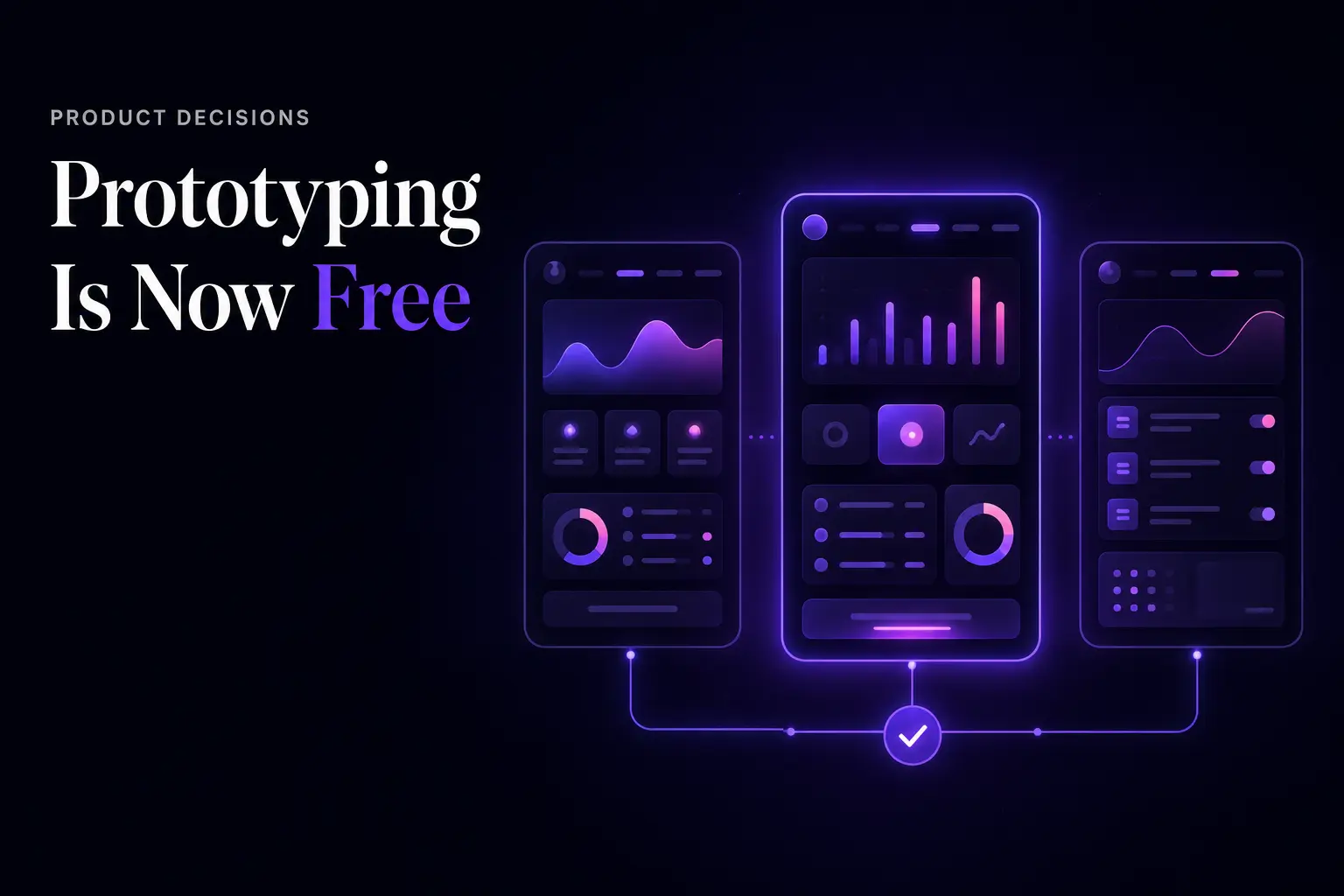
When a working version of each option takes an afternoon, the debate becomes unnecessary. Build all three. Click through them. The right answer usually announces itself the moment the options are sitting side by side, because judgment about a real thing is far more reliable than judgment about a described thing. The discussion moves from opinion to observation, which is where product decisions belong.
Let a working prototype carry the spec
A written specification is an attempt to describe an experience in words so that someone else can rebuild that experience in their head. It is a lossy format. Two people read the same PRD and picture two different products, and the gap only surfaces weeks later when the built thing does not match what anyone imagined.
A working prototype closes that gap. It communicates the idea directly, with no translation step in between. Everyone in the room is reacting to the same concrete thing, which means the feedback is about the actual product instead of about competing interpretations of a paragraph. Written detail still matters for the parts a prototype cannot show, but the prototype now does the heavy lifting of alignment that documents used to do poorly.
Put something real in front of users
For a long time, early user feedback meant showing people wireframes or static mockups and asking them to imagine the rest. People are gracious in those sessions, and they are also guessing. Asking someone how they feel about a picture of a product tells you far less than watching them try to use the product.
Now you can hand users something real to click on well before you have committed to building it properly. The feedback you get from that is a different category of useful. You see where they hesitate, what they tap that does nothing, which step they abandon. That is the kind of signal that actually redirects a product, and it arrives early enough to act on cheaply.
What does not become free
It is worth being clear about the edge of this. Prototyping becoming free does not make everything free. Two things in particular still ask for real skill and real work.
The first is judgment about what is worth building at all. A tool that generates ten prototypes in a morning does not tell you which of the ten deserves to exist. Taste, market understanding, and a clear sense of the problem still come from people, and they matter more now, not less, because the volume of options has gone up.
The second is everything that happens after a prototype earns the right to become a product. A convincing demo and a system real users can depend on are separated by testing, security, architecture, and code someone actually understands. We wrote about that gap in more detail in our piece on moving from vibe coding to production-ready AI. Free prototyping gets you to the right decision faster. It does not carry that decision the rest of the way to production.
How we work with founders on this
The founders we work with at Appening who have internalized this are, in our experience, making better product decisions and making them faster than before. The change is less about any single tool and more about a habit: when you are unsure, you build the thing and look at it, rather than debating it in the abstract.
Our role tends to sit on both sides of that line. We help teams use prototyping to explore quickly and decide well, and then we bring engineering judgment to the parts that turn a chosen direction into something dependable. The speed at the front of the process is only valuable if the fundamentals hold up at the back of it.
If you are building a product right now and want a faster, more honest way to decide what to build, we are happy to help you set that loop up. Book a free 30-minute consultation and we will walk through where prototyping can save you time and where careful engineering still earns its keep.
Table of Contents